
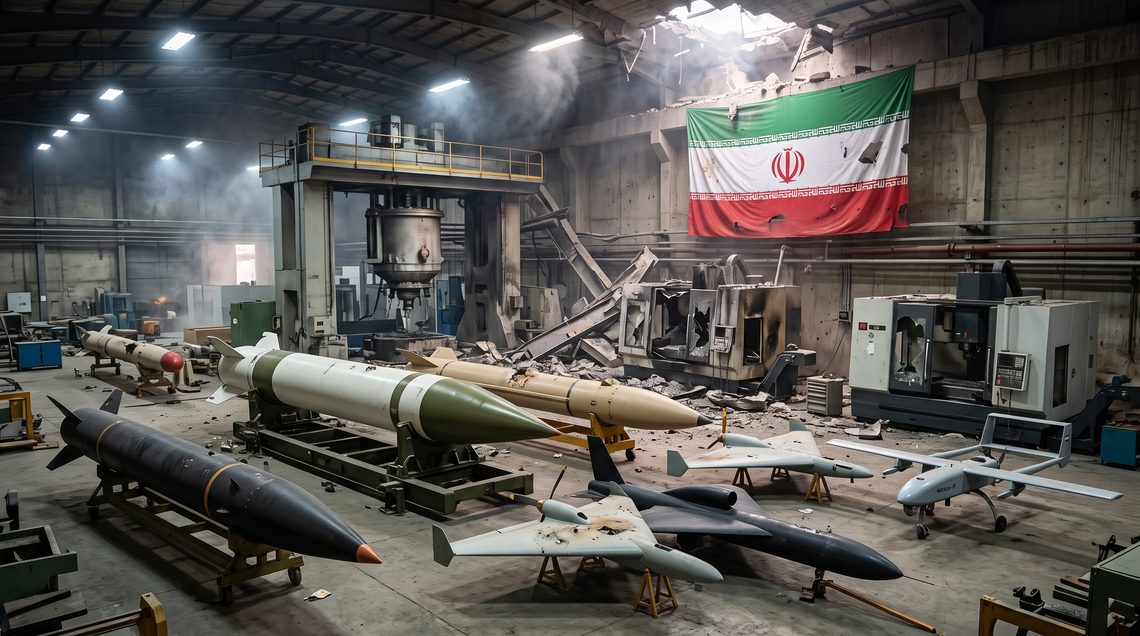
A deeper look at the impact of war on one of the most effective tools the Iranian regime has, what capacities remain, what is the economic consequence of an efficient rehabilitation and what are the most probable scenarios
Abstract
This article examines the technological evolution, 2024–2026 combat degradation, and projected three-year rehabilitation strategy (October 2026–September 2029) of the Islamic Republic of Iran’s ballistic missile, rocket, and unmanned aerial vehicle (UAV) arrays. Serving as the primary instrument for inflicting asymmetric economic and strategic pain on its adversaries, Iran’s missile and drone ecosystem—spanning both the Ministry of Defence and Armed Forces Logistics (MODAFL) industrial subsidiaries and the Islamic Revolutionary Guard Corps Aerospace Force (IRGC-ASF)—faces an unprecedented crisis following three distinct waves of U.S. and Israeli precision strikes between October 2024 and Spring 2026.
Tracing the trajectory from foreign dependency during the Iran-Iraq War (1980–1988) to indigenous autarky in Research and Development (R&D), this study synthesizes satellite imagery Battle Damage Assessments (BDA) and open-source intelligence (OSINT) across key production hubs, including Khojir, Parchin, Shahroud, Hakimiyeh, Isfahan, Shahin Shahr, and Qom. It establishes a critical methodological distinction between visible structural repair, near-term weapon assembly utilizing pre-existing component stockpiles, and the full restoration of upstream industrial processes. Furthermore, the paper deconstructs Iran’s “hypersonic” missile claims (Fattah-1 and Fattah-2), separating psychological warfare from aerospace engineering reality by contrasting operational Maneuverable Re-entry Vehicles (MaRVs) with unproven Hypersonic Glide Vehicles (HGVs). Finally, weighing solid-propellant bottlenecks (planetary mixers) against storable hypergolic liquid-fuel bridges (Khorramshahr-4), dispersed UAV networks, and the absolute primacy of domestic regime survival, the article presents a dual-track, scenario-based financial allocation model ($7B–$15B for industrial base restoration alongside $5B–$7B for serial munition replenishment) over a 36-month horizon.
1. Historical Evolution and Institutional Architecture: From Foreign Dependency to Indigenous Autarky
The doctrinal obsession of the Islamic Republic with ballistic missiles and unmanned systems is rooted in the trauma of the Iran-Iraq War (1980–1988), specifically the “War of the Cities” (Jang-e Shahrha). While lacking a functioning air force due to Western embargoes following the 1979 revolution, Iran was subjected to relentless Iraqi Scud-B strikes without an effective means of retaliation. This vulnerability forged a foundational strategic axiom in Tehran: ballistic missiles and drones must serve as a “substitute air force” capable of assuring deterrence through punishment (Eisenstadt, 1996; Ostovar, 2016).
A. Institutional Architecture: Distinguishing the Industrial Base from Operational Forces
A rigorous assessment of damage and reconstitution requires a clear distinction between the bureaucratic-industrial organs of Iran’s Ministry of Defence (MODAFL) and the operational branches of the IRGC. Striking a factory, a storage depot, or a launch base affects different layers of a complex ecosystem:
● Aerospace Industries Organization (AIO): A MODAFL organization overseeing Iran’s broader ballistic-missile industrial programme and its subordinate industrial groups (such as the Shahid Hemmat Industrial Group [SHIG] for liquid-fuel missiles and the Shahid Bakeri Industrial Group [SBIG] for solid-fuel systems). AIO’s remit encompasses R&D, propellant chemistry, metallurgy, and foreign procurement networks (Iran Watch, 2025).
● Iran Aviation Industries Organization (IAIO) and HESA: IAIO is a separate MODAFL entity responsible for the broader aviation sector. Its key subsidiary, the Iran Aircraft Manufacturing Industrial Company (HESA) based at Shahin Shahr (Isfahan), is a primary industrial manufacturer of the Ababil and Shahed UAV families.
● IRGC Aerospace Force (IRGC-ASF) and Shahed Aviation Industries: The IRGC-ASF is the military service responsible for commanding and operating Iran’s strategic ballistic missile and UAV forces. Beyond operational bases and subterranean “missile cities,” the IRGC-ASF maintains its own dedicated R&D and manufacturing wings, most notably Shahed Aviation Industries (sanctioned for designing and producing the Shahed-136, Shahed-129, and Shahed-238 variants) and the Self-Sufficiency Jihad Organization (Critical Threats, 2026).
B. Phase I: Foreign Acquisition and Reverse Engineering (1985–1999)
Iran’s entry into missilery began in 1985 with the urgent acquisition of Soviet-designed Scud-B (R-17E) missiles from Libya and Syria, quickly followed by direct cooperation with North Korea. Under the leadership of Brig. Gen. Hassan Tehrani Moghaddam, the IRGC established a symbiotic relationship with Pyongyang: Iran provided hard currency and oil, while North Korea supplied Hwasong-5 (Scud-B) and Hwasong-6 (Scud-C) kits, assembled in Iran as the Shahab-1 and Shahab-2 (Elleman, 2010).
During the 1990s, this dependency expanded across three external pillars (Reuters, 2026b):
● North Korea: Transferred the medium-range Nodong-1 liquid-fuel engine technology, forming the basis of the Iranian Shahab-3 (1,300 km range), and later supplied the Musudan (BM-25) hypergolic propulsion architecture.
● Russia: Following the Soviet collapse, Russian aerospace entities provided vital metallurgical knowledge, wind-tunnel testing, gyroscope guidance components, and blueprints for high-energy liquid propellants before U.S. diplomatic pressure curtailed official transfers in the late 1990s (Katzman, 2022).
● China: Beijing played a decisive role in introducing Iran to solid-propellant technology and tactical guidance, transferring WS-1 and M-7 (CSS-8) artillery rocket technologies and assisting AIO in establishing its first solid-fuel production plants in Parchin and Shahroud. This laid the groundwork for the indigenous Zelzal and Fateh-110 series (IISS, 2023).
C. Phase II: Indigenous R&D and the Military-Academic Complex (2000–Present)
Recognizing that foreign supply lines were vulnerable to interdiction, Iran initiated a transition from reverse engineering (Mohandesi-ye Ma’kous) to indigenous R&D autarky (Khod-Kafa’i). This shift was operationalized by integrating elite civilian academia—most notably Sharif University of Technology, Amirkabir University, Malek-Ashtar University, and the IRGC’s Imam Hossein University—into AIO and IRGC-ASF research directorates.
By the 2020s, Iran achieved genuine design autonomy across four critical vectors:
● Precision Strike Revolution (CEP Reduction): Reducing Circular Error Probable (CEP) from over 1,000 meters to 10–30 meters by integrating indigenous electro-optical seekers, ring-laser gyroscopes, and combined INS/GPS/GLONASS/BeiDou satellite navigation systems into maneuverable warheads (Fateh-110, Zolfaghar, Emad) (Rubin, 2020). Across the broader arsenal, this evolutionary progression yielded a diverse operational inventory spanning short-range (300–1,000 km) liquid-fuel missiles (Shahab-1, Shahab-2, Qiam-1, Qiam-2) and solid-fuel systems (Fateh-110, Fateh-313, Fateh Mobin, Zolfaghar, Zolfaghar-e-Basir, Dezful, Ra’ad-500, and anti-ship variants Khalij Fars and Hormuz); medium-range (1,000–3,000 km) liquid-fuel missiles (Shahab-3, Ghadr, Emad, Rezvan, Khorramshahr) and solid-fuel MRBMs (Sejjil, Haj Qasem, Kheibar Shekan, Fattah-1); alongside land-attack and anti-ship cruise missiles (Soumar, Hoveyzeh, Paveh, Abu Mahdi, Ya Ali, and Quds-1/2) (Alma Research and Education Center, 2026).
● Composite Airframes and Solid Rocket Motors (SRMs): Replacing heavy steel missile bodies with carbon-fiber composite casings (Raad-500 and Kheibar Shekan), reducing missile weight by up to 50%, extending range to 1,450+ km, and integrating movable nozzles for thrust-vector control (TVC).
● Cluster Munition and Maneuvering Warheads: Developing difficult-to-intercept cluster munition warheads (dispersing dozens of submunitions over wide areas) and exo-/endo-atmospheric Maneuverable Re-entry Vehicles (MaRVs) (Reuters, 2026b).
● The UAV Industrial Complex: Evolving from rudimentary 1980s reconnaissance planes into global leaders in low-cost, delta-wing loitering munitions (Shahed-131/136 and Arash-2), jet-powered kamikaze drones (Shahed-238), and Medium-Altitude Long-Endurance (MALE) UCAVs (Mohajer-6, Shahed-149 Gaza). Prior to the 2025–2026 conflict, Western estimates placed Iran’s total UAV inventory at 8,000 to 80,000 drones across all models, backed by a peacetime surge assembly capacity estimated at up to 10,000 one-way attack units per month (Deutsche Welle, 2026).
2. Empirical Damage Assessment (2024–2026): Chronology, Facilities, and the Five Layers of Industrial Recovery
Between October 2024 and Spring 2026, Iran’s aerospace industrial base was subjected to three progressively devastating waves of airstrikes. Crucially, these campaigns did not merely target launch sites or finished weapons; they systematically targeted upstream manufacturing equipment, propellant chemistry, and propulsion plants.
A. The Three-Wave Chronology of Industrial Degradation
● Wave I: The October 2024 Israeli Strikes (Targeting the Solid-Fuel Bottleneck): High-resolution satellite imagery analyzed by The Washington Post (2024) confirmed precision strikes against Parchin, Khojir, and Shahroud. At least five specialized buildings were hit at Parchin and Khojir, alongside a solid-propellant casting facility at Shahroud. The primary targets were heavily regulated vertical planetary mixers and casting curing ovens, creating an immediate upstream bottleneck in Iran’s ability to pour solid-fuel rocket motors.
● Wave II: The June 2025 Israel–Iran 12-Day War and the “Empty Shell” Reconstruction: During the intense 12-day conflict in June 2025, Iran launched over 900 ballistic missiles, expending more than a third of its estimated 2,500-missile pre-war medium-range ballistic missile (MRBM) stockpile—out of an overall pre-war arsenal of approximately 3,000 ballistic missiles across all ranges and 410–470 mobile launchers (TELs) (AP, 2025; Alma Research and Education Center, 2026). Allegedly, in response, the Israeli Air Force (IAF) eliminated the Commander of the IRGC-ASF on June 13, 2025, compromised Iran’s strategic air defense network (S-300PMU2 and Bavar-373 radars), and executed wide-scale waves of strikes (June 15–20, 2025) against Tehran-area missile raw-material, component, navigation, and UAV storage facilities (IDF, 2025a, 2025b, 2025c, 2025d).
● The Reconstruction Illusion (September 2025 – February 2026): Satellite imagery analyzed by the Associated Press in September 2025 revealed rapid Iranian construction at Parchin and Shahroud, including repaired mixer buildings and control power structures (AP, 2025). However, intelligence analysts noted that replacement planetary mixers were missing—proving that repairing a building’s roof does not equate to restoring its production line. By February 2026, Reuters documented Iran burying tunnel entrances at Isfahan and Natanz, repairing missile base roofs in Shiraz and Qom, and constructing a soil-camouflaged concrete “sarcophagus” over the newly rebuilt Taleghan 2 facility inside Parchin (Reuters, 2026a).
● Wave III: The February–April 2026 U.S.–Israeli Campaign (System-Wide Disruption): Beginning on February 28, 2026, a coordinated U.S.–Israeli campaign struck across the depth of Iran’s military-industrial complex, hitting at least four major missile production complexes and 29 launch sites, destroying hundreds of mobile launchers (TELs) (Washington Post, 2026; Reuters, 2026b). By April 2026, assessments indicated that roughly 50% of Iran’s pre-war fleet of 410–470 mobile launchers had been destroyed or rendered inoperable—though a portion of the “out-of-use” launchers and missiles remained intact inside subterranean complexes whose tunnel portals were collapsed or buried, meaning they can be restored to operational service once excavated (ISW, 2026b). Across the broader conflict, Iran also launched approximately 4,400 UAVs while U.S. and Israeli strikes destroyed roughly 1,000 additional drones in storage depots; while this expenditure represented only a fraction of Iran’s massive pre-war UAV stockpile, the accompanying strikes severely degraded centralized drone and engine manufacturing facilities. A comprehensive March 29, 2026 Washington Post satellite investigation—corroborated by the Institute for the Study of War (ISW) and Critical Threats Project (March 2–30, 2026)—documented massive structural destruction: 88 destroyed structures at Khojir, 28 damaged or destroyed structures at Shahroud, 19 structures hit at Hakimiyeh (affecting liquid-propellant and TEL production), and 12 structures hit at Parchin. Simultaneously, strikes expanded to the UAV and engine sector, hitting HESA’s Shahin Shahr complex (9 impact points, 5 buildings visibly damaged), Shahed Aviation Industries in Isfahan (including the Khomeynishahr plant), and a turbojet-engine factory in Qom. Even after these strikes, imagery from June–July 2026 showed Iran doggedly resuming debris clearance and hardening at Parchin’s Taleghan 2 (ISIS, 2026a) and adding passive defenses at joint Russian-Iranian drone sites like the Alabuga SEZ (ISIS, 2026b).
Table 1: Facility-by-Facility Battle Damage Assessment (2024–October 2026)
| Industrial Cluster / Facility | Organizational Affiliation | Documented Satellite & OSINT Damage (2024–2026) | Primary Capability & Industrial Process Affected |
| Khojir Complex (Tehran Province) | AIO (SHIG / SBIG) | Struck Oct 2024; devastated in March 2026 (at least 88 structures destroyed, including mixing/casting buildings). | Solid- and liquid-fuel missile production, motor casting, components, and final assembly. |
| Shahroud Complex (Semnan Province) | AIO / IRGC-ASF | Struck Oct 2024; roofs repaired Sept 2025 (without mixers); 28 structures damaged/destroyed in March 2026 (panels blown out, casting/NDT sites hit). | Large-diameter solid-fuel rocket motors, space launch vehicles (SLVs), and missile R&D. |
| Parchin Complex & Taleghan 2 | MODAFL / AIO | Struck Oct 2024 & June 2025; concrete “sarcophagus” built Feb 2026; 12 structures hit in March 2026; further rehab seen July 2026. | Solid-propellant mixing/casting, high-explosive testing, and ammunition manufacturing. |
| Hakimiyeh (Tehran East) | AIO | 19 structures hit in March 2026 satellite imagery assessment. | Liquid-propellant missile production, R&D, and mobile missile-launcher (TEL) fabrication. |
| HESA Complex (Shahin Shahr, Isfahan) | MODAFL / IAIO | Struck March 1–2, 2026 (at least 9 impact points; 5 major buildings damaged). | Serial airframe manufacturing and integration for Ababil and Shahed UAV series. |
| Shahed Aviation Industries (Isfahan) | IRGC-ASF Affiliated | Major strike damage documented at Isfahan / Khomeynishahr drone plants (March 3–12, 2026 CENTCOM/OSINT imagery). | Primary airframe and assembly lines for Shahed-136, Shahed-129, and Shahed-238 UAVs. |
| Qom Turbojet Plant & Shiraz/Qom Bases | MODAFL / IRGC-ASF | Missile bases struck in 2025 (roof repairs in Feb 2026); Qom turbojet-engine factory struck in March 2026. | Micro-turbojet engine production (Toloue series) for high-speed UAVs (Shahed-238) and cruise missiles (Paveh, Hoveyzeh, Soumar). |
| Tehran Component & Subsystems Plants | AIO / MODAFL Subsidiaries | Struck by 50+ IAF jets in June 2025; IRGC-ASF HQ targeted Feb 2026; AIO central bureaucracy remains intact. | Raw materials, navigation/guidance subsystems, and air-defense components across multiple weapon families. |
Sources: Compiled from The Washington Post (2024, 2026), AP/Iran Watch (2025), CSIS (2026a), ISW/Critical Threats (2026a, 2026b, 2026c), ISIS (2026a), Reuters (2026a), and IDF releases (2025, 2026).
B. The Five Analytical Layers of Industrial Recovery and Sanctions Efficacy
As assessments by the Center for Strategic and International Studies (CSIS, 2026a) and War on the Rocks (2026) emphasize, visible damage to factory roofs does not automatically prove that production has ceased; conversely, rebuilding a roof does not mean production has resumed. Furthermore, satellite imagery cannot observe the condition of machinery inside deep underground facilities.
To avoid deterministic errors, Iran’s post-strike industrial bottlenecks must be evaluated across five distinct analytical layers:
1. Physical Sites and Utilities: Surface buildings at Khojir, Parchin, Shahroud, and Hakimiyeh were heavily degraded, and strategic air defenses were crippled. While surface warehouses can be rebuilt in months, exposed sites remain vulnerable to repeat strikes, forcing a shift toward underground complexes and hardened concrete sarcophagi.
2. Production Equipment and Tooling (The Primary Bottleneck): Replacing specialized industrial machinery takes far longer than pouring concrete.
○ Planetary Mixers: Military-spec vertical planetary mixers (1,000L–2,000L) required to blend volatile solid propellant (HTPB binder, aluminum powder, and ammonium perchlorate oxidizer) under vacuum with zero dead spots and spark-free thermal control cost ~$2 million USD per unit (reaching $3M–$3.5M with black-market smuggling premiums), compared to $10,000–$120,000 for commercial food/chemical mixers. Regulated under the MTCR and Wassenaar Arrangement, their loss throttles large-diameter solid rocket motor casting. Even after illicit delivery, mixers require months of installation, calibration, safety certification, and process validation.
○ Precision Machine Tools: 5-axis CNC machines, flow-forming lathes, and non-destructive testing (NDT) X-ray chambers (damaged at Shahroud) are critical bottlenecks for both missile airframes and Qom’s turbojet engines.
3. Critical Inputs and Dual-Use Imports: Domestic assembly remains tethered to foreign inputs. While the U.S. Department of the Treasury’s 2025–2026 “Economic Fury” campaign and EU sanctions (Regulation 2025/1559) aggressively targeted procurement networks in China, Hong Kong, the UAE, and Türkiye (U.S. Department of the Treasury, 2025a, 2025b, 2026a, 2026b; Council of the EU, 2025), sanctions efficacy is uneven: high-grade aerospace materials (maraging steel, T-800 carbon fiber) face friction, whereas commercial dual-use microelectronics (FPGAs, GNSS modules) and domestic petrochemical liquid precursors (UDMH/IRFNA) continue to flow.
4. Skilled Personnel, Testing, and Quality Assurance (QA): Casualties among specialist technicians and the loss of testing infrastructure degrade process quality. A damaged line may fabricate parts, but without rigorous QA and calibration, defect rates surge—leading to in-flight motor explosions or guidance failures (GCIRD, 2026).
5. Stockpiles and the “Assembly vs. Manufacturing” Distinction: The most critical analytical insight (War on the Rocks, 2026) is that Iran can continue assembling finished missiles and drones in the near term from pre-existing hidden inventories of subassemblies (engines, warheads, guidance kits) and excavating intact weapons and launchers from buried subterranean complexes even while its upstream manufacturing plants lie in ruins. Sustaining launches or displaying weapons in parades is therefore an ambiguous indicator that does not prove end-to-end industrial recovery.
3. Deconstructing the “Hypersonic” Myth: Separating Strategic Propaganda from Aerospace Reality
A central pillar of Tehran’s deterrence messaging—designed to compensate for the degradation of its conventional air defenses and missile factories—is the claim that it possesses operational “hypersonic weapons” capable of rendering U.S. and Israeli missile defenses obsolete. Because the term “hypersonic” generates acute alarm among Western publics and Gulf investors, academic analysis must separate IRGC psychological warfare from verified aerospace engineering reality.
Cross-referencing technical evaluations from the IISS, CSIS, the Stimson Center, and Jane’s reveals a deliberate semantic manipulation by Tehran regarding the Fattah-1 (unveiled June 2023) and the Fattah-2 (unveiled November 2023).
A. The Semantic Manipulation: Terminal Speed vs. Sustained Hypersonic Glide
In basic physics, virtually all Medium-Range Ballistic Missiles (MRBMs)—reaching speeds up to 17,000 km/h (Mach 14) during terminal descent (Reuters, 2026b)—are technically traveling at “hypersonic speeds” (Mach 5+). However, in modern military classification, a true hypersonic weapon must both exceed Mach 5 and sustain aerodynamic lift and high-G maneuverability inside the atmosphere across a non-ballistic trajectory:
● Hypersonic Glide Vehicles (HGVs): Boosted by a rocket into the upper atmosphere, where the warhead detaches early and skips/glides horizontally at Mach 5+ across thousands of kilometers using aerodynamic lift (e.g., China’s DF-ZF or Russia’s Avangard).
● Hypersonic Cruise Missiles (HCMs): Powered throughout their atmospheric flight by an air-breathing scramjet (supersonic combustion ramjet) engine.
Independent missile specialists—including Fabian Hinz (IISS), Uzi Rubin (JISS), and Jeffrey Lewis (CNS)—unanimously concur that Iran does not possess an operational scramjet (HCM), and its primary fielded weapon (Fattah-1) is not a true HGV (Hinz, 2023; Rubin, 2023).
B. Technical Deconstruction of Fattah-1: An Advanced MaRV, Not an HGV
When Iran unveiled the Fattah-1, claiming speeds of Mach 13–15 and immunity to interception, forensic analysis of its airframe and combat debris from the 2024–2026 exchanges revealed a more conventional architecture:
● Engineering Architecture: Fattah-1 pairs a solid-fuel ballistic booster (derived from the Kheibar Shekan) with a conical Maneuverable Re-entry Vehicle (MaRV). The warhead houses a secondary, smaller spherical solid-propellant rocket motor with a movable nozzle (Thrust Vector Control – TVC) and four aerodynamic control fins.
● Operational Reality vs. Propaganda: The TVC motor allows Fattah-1 to execute brief velocity and course corrections in the vacuum of space (exo-atmospheric) to complicate trajectory prediction for interceptors like Arrow-3, and to pull high-G evasive turns during the final seconds of atmospheric re-entry. While this represents a major evolutionary advance that forces defenders to expend more interceptors, it follows a classic ballistic arc for over 90% of its flight. Even defense commentators within Iran have quietly conceded that Fattah-1 is “quasi-hypersonic” rather than a true boost-glide vehicle (Hinz, 2023).
C. The Fattah-2 Controversy: “Hypersonic Cruise Glide” or Unproven Mockup?
Recognizing that Western intelligence had categorized Fattah-1 as an advanced MaRV, the IRGC unveiled the Fattah-2 in November 2023. Unlike the conical Fattah-1, the Fattah-2 displayed a flat, wedge-shaped waverider geometry—the hallmark of a true HGV—while Iranian state media confusingly labeled it a “Hypersonic Cruise Glide Missile” with a liquid-fuel second stage.
Cross-referenced technical assessments cast severe doubt on the operational existence of Fattah-2 based on four engineering red flags:
1. The Propulsion Contradiction (“Cruise” vs. “Rocket-Assisted Glide”): As Jane’s (Binnie, 2023) noted, Iran claimed Fattah-2 uses a solid booster and a liquid-fuel engine inside the glide vehicle. A true HCM requires an air-breathing scramjet, demanding exotic metallurgy and supersonic wind tunnels Iran lacks. If Fattah-2 houses a small liquid-fuel rocket engine (likely hypergolic UDMH/N2O4), it is a powered boost-glide concept—using rocket thrust to overcome aerodynamic drag because Iran lacks the aerodynamic refinement for unpowered hypersonic glide.
2. Absence of Flight-Test Telemetry: Mastering hypersonic waverider aerodynamics is notoriously difficult. Whereas every operational Iranian missile unveiling is accompanied by launch and impact videos, Iran unveiled Fattah-2 inside an exhibition hall with zero flight-test footage (Czulda, 2023), and Iranian officials subsequently denied rumors that it had been test-fired.
3. The “Plasma Blackout” and Thermal Soak Barrier: Gliding horizontally through the atmosphere at Mach 10–15 generates prolonged friction heating exceeding 2,500°C–3,000°C, wrapping the vehicle in an ionized plasma sheath that blocks satellite navigation signals (GPS/GLONASS) and blinds guidance systems, while uneven thermal ablation warps the airframe. Under strict embargoes on Ultra-High-Temperature Ceramics (UHTCs), there is no evidence Iran has solved prolonged thermal soak or plasma blackout.
4. Forensic Absence in 2024–2026 Combat: Despite Iranian media claims, forensic OSINT analysis of missile wreckage from the October 2024, June 2025, and Spring 2026 salvos identified exclusively conical MaRV warheads (Fattah-1 and Kheibar Shekan), cluster warheads, and liquid-fuel Emad/Ghadr/Khorramshahr boosters. No physical evidence of a wedge-shaped Fattah-2 HGV has ever been recovered.
Table 2: Iranian “Hypersonic” Claims vs. Independent Intelligence Consensus
| Weapon System | Official Iranian Claim (Propaganda) | Cross-Referenced Technical Reality (IISS, CSIS, Jane’s) | Operational & Rehabilitation Status (Oct 2026) |
| Fattah-1 | “First indigenous hypersonic missile” (Mach 13–15); completely immune to all Western/Israeli air defenses. | Ballistic MRBM with a TVC-assisted MaRV. Uses a secondary solid motor in a conical warhead for late-stage evasive maneuvers. Not a true HGV. | Operational & Combat-Proven. Complicates interception, but production is currently throttled by the 2024–2026 destruction of solid-fuel planetary mixers at Khojir/Shahroud. |
| Fattah-2 | “Hypersonic Cruise Glide Vehicle” (HGV/HCM) capable of sustained Mach 15 atmospheric flight. | Unproven Mockup / Powered HGV Concept. Wedge-shaped waverider allegedly using an internal liquid-fuel rocket thruster rather than a scramjet. | Aspirational R&D. Zero verified flight tests or combat debris from the 2025–2026 wars. Severe doubts regarding thermal ablation and plasma blackout. |
| True Scramjet HCM | Implied by IRGC rhetoric regarding “hypersonic cruise” dominance. | Non-Existent. Requires supersonic combustion ramjets, exotic metallurgy, and wind tunnels monopolized by the US, China, and Russia. | Psychological Warfare. Aimed at frightening Western publics and deterring Gulf states. |
4. Strategic Logic of the Three-Year Rehabilitation Plan (Oct 2026–Sept 2029)
Evaluating Iran’s reconstitution logic after the Spring 2026 strikes requires synthesizing both sides of the attrition equation. While Iran’s missile factories and launcher fleets were severely battered, the conflict simultaneously depleted U.S. and allied stocks of exquisite, multi-million-dollar air-defense interceptors (SM-3, THAAD, Patriot PAC-3, Arrow). As a May 2026 CSIS analysis and subsequent reports in The Wall Street Journal (October 2026) and Financial Times (June 2026) revealed, the U.S. military faces a minimum three-year bottleneck to replenish its advanced munitions, prompting the Pentagon to appoint private-equity leadership (Steve Feinberg) to overhaul procurement and pursue a “$12 billion McDonald’s model” of cheap, mass-produced missiles (CSIS, 2026b; Financial Times, 2026a; Wall Street Journal, 2026).
Tehran’s strategic planners acutely understand this mutual exhaustion. With 30%–35% of Iran’s security budget locked into domestic regime survival (IRGC/Basij salaries and ethnic counter-insurgency), Iran will not attempt to rebuild everything at once. Instead, its recovery will follow an uneven, tiered trajectory across three distinct recovery windows (Washington Institute, 2026; War on the Rocks, 2026):
A. Tier 1 (6–12 Months): The Dispersed UAV Rebound, Inventory Assembly, and Stopgap Air Defense
● The 6–12 Month UAV Recovery Window: Although Iran expended approximately 4,400 UAVs in combat and lost another ~1,000 in depot strikes—leaving substantial residual reserves from its pre-war inventory of 8,000–80,000 drones—the March 2026 strikes on HESA (Shahin Shahr) and Shahed Aviation Industries (Isfahan) heavily damaged centralized serial production lines. Nevertheless, a May 2026 Washington Institute assessment concludes that mass production of long-range one-way attack drones (Shahed-131/136) can recover within 6 to 12 months (Washington Institute, 2026). Simple composite airframes and two-stroke piston engines (Mado MD-550) are easily dispersed across underground workshops and civilian garages (“the hidden layer” of Iran’s drone industry). However, because the March 2026 strike damaged the Qom turbojet factory, production of jet-powered Shahed-238 drones and land-attack cruise missiles (Paveh, Hoveyzeh, and Soumar) will face a longer 12–18-month bottleneck.
● Dual-Use Internal Security Utility: Investing in UAVs first satisfies both external attrition (imposing a $20,000 vs. $2,000,000 cost-exchange ratio on GCC and Western defenses, as seen in early 2026 threats to Qatari, Kuwaiti, and Saudi energy infrastructure [Reuters, 2026b]) and internal regime survival. Tactical UCAVs (Mohajer-6, Ababil) provide immediate ISR and strike coverage for IRGC Ground Forces suppressing Kurdish, Baluchi, and Arab separatists.
● Tactical Air-Defense Stopgaps (The Chinese MANPADS Deal): Because the 2025–2026 strikes crippled Iran’s strategic air defenses and Iran lacks the hard currency to buy Russian S-400s, Tehran is pursuing mobile, asymmetric air denial. In July 2026, Reuters revealed that Iran signed a $60–$70 million emergency contract with a Hong Kong intermediary (Zhongqing Baoshang International Investment) to acquire 300–400 Chinese QW-12 and FN-16 MANPADS, shipped from Urumqi overland through Pakistan, to protect reconstruction sites against low-flying threats and cruise missiles (Reuters, 2026c).
B. Tier 2 (12–24 Months): The Liquid-Fuel (Khorramshahr) Bridge and TEL Reconstitution
While our earlier theoretical model assumed liquid-fuel infrastructure was largely unscathed, the March 2026 strikes on Hakimiyeh (19 buildings hit) and Khojir (88 buildings hit) proved that liquid-propellant missile and launcher facilities suffered heavy surface damage. Nevertheless, liquid-propellant MRBMs remain a much faster medium-term bridge (12–24 months) than solid-fuel MRBMs for three reasons:
1. Bypassing the Planetary Mixer Bottleneck: Fabricating aluminum/steel tanks and turbopumps for Emad, Ghadr, and Khorramshahr-4 missiles requires general-purpose CNC lathes and welding gear—not irreplicable $2M explosion-proof planetary mixers. Furthermore, Iran retains hidden stockpiles of engine components that can be assembled in dispersed workshops (War on the Rocks, 2026).
2. The Ampoulized Hypergolic Advantage (Khorramshahr-4): Utilizing domestically produced UDMH fuel and N2O4 oxidizer, the Khorramshahr-4 features factory-welded (“ampoulized”) tanks that allow the missile to be stored fully fueled in underground tunnels for 3 to 5 years and launched within 12–15 minutes. This gives Iran solid-fuel readiness speeds using liquid-fuel industrial workarounds, alongside a massive 1,500–1,800 kg warhead (or cluster munition payload).
3. Solving the Launcher (TEL) Deficit: Having lost hundreds of launchers in Spring 2026—disabling roughly 50% of its pre-war fleet of 410–470 TELs (Reuters, 2026b; ISW, 2026b)—missile stockpiles are useless without launch platforms. In the immediate term (Months 1–6), Iran can partially mitigate this bottleneck by excavating and restoring intact launchers and missiles that were sealed inside collapsed underground tunnel complexes during the war (ISW, 2026b). In Months 6–24, Iran will prioritize converting commercial heavy semitrailers and shipping containers into disguised TELs and building subterranean rail-launch apertures to bypass the destruction at Hakimiyeh and replace older imported Russian/Belarusian heavy wheeled chassis.
C. Tier 3 (24–36+ Months): Subterranean Fortification and Solid-Fuel Reconstitution
The repeated destruction of surface buildings at Parchin, Khojir, and Shahroud in October 2024, June 2025, and March 2026—even after Iran attempted rapid roof repairs and built concrete sarcophagi in late 2025/early 2026—taught the IRGC a definitive lesson: above-ground solid-propellant casting is unsustainable without strategic air defense.
Consequently, restoring pre-war, high-volume output of advanced solid-fuel missiles (Kheibar Shekan, Fattah-1 MaRV) and domestic supply chains will require at least two to three years (War on the Rocks, 2026). Khatam al-Anbiya must first excavate deep subterranean industrial halls (100+ meters under granite mountains) while AIO procurement networks in China and Hong Kong smuggle replacement planetary mixers, install them underground, calibrate vacuum/thermal controls, and pass QA validation.
5. Dual-Track Financial Assessment: Industrial Base Reconstitution vs. Munition Production Pricing (Oct 2026–Sept 2029)
A major source of confusion in defense economics is conflating the Industrial Reconstitution Budget (reconstructing bombed sites, replacing destroyed machine tools, re-establishing supplier networks, and funding QA/workforce overhead) with the Unit Serial Production Budget (the marginal cost of manufacturing individual missiles and drones to replenish expended stockpiles).
As CSIS (2026a) notes, there is no audited public ledger of Iran’s post-strike spending, and underground damage remains an intelligence gap. Therefore, a rigorous financial model must separate Industrial Base Rehabilitation Scenarios from Unit Replenishment Costs, while accounting for procurement friction (intermediary fees from “Sanctions Profiteers” [Kasabkaran-e Tahrim], currency depreciation of the Rial, and delayed deliveries).
A. Track 1: The Three-Year Industrial Base Rehabilitation Budget ($7B–$15B Central Scenario)
Focusing strictly on restoring the physical and organizational capacity to manufacture weapons (excluding the cost of the finished munitions themselves), financial projections for October 2026–September 2029 fall into three broad macro-scenarios:
● Scenario A – Constrained Recovery ($3 Billion – $6 Billion): Selective repairs of high-priority sites; reliance on existing component stockpiles and dispersed cottage-industry drone assembly; persistent mixer and machine-tool shortages.
● Scenario B – Partial / Central Industrial Recovery ($7 Billion – $15 Billion): The most plausible central planning range. Encompasses substantial subterranean construction, replacement of key planetary mixers and CNC tools via Chinese/Turkish front networks, restoration of domestic supplier chains, and QA testing recovery.
● Scenario C – Ambitious Reconstitution ($15 Billion – $25 Billion): Comprehensive industrial restoration, full underground redundancy across all AIO/IRGC-ASF clusters, and expanded R&D despite severe sanctions friction.
Table 3: Industrial Base Rehabilitation Allocation Model (Central Scenario: $7B–$15B, Oct 2026–Sept 2029)
| Industrial Cost Category | Illustrative Share | 3-Year Cost Range (2026 USD) | Specific Post-2026 Reconstitution Requirements |
| 1. Site Restoration, Subterranean Excavation & Utilities | 15% – 25% | $1.1B – $3.8B | Clearing debris at Khojir/Shahroud/Hakimiyeh; excavating buried subterranean missile/launcher depots; constructing concrete “sarcophagi” (like Taleghan 2); Khatam al-Anbiya boring deep underground factory halls and power grids. |
| 2. Replacement of Damaged Capital Equipment & Tooling | 20% – 30% | $1.4B – $4.5B | Rebuilding domestic sub-contractor networks hit in June 2025/March 2026; bulk importing maraging steel, carbon fiber, and commercial microelectronics. |
| 4. Workforce, Calibration, Testing & Quality Assurance (QA) | 10% – 15% | $0.7B – $2.3B | Retaining/replacing specialist engineers and operators; machine calibration, safety certification, and static motor test-stand validation to prevent batch defects. |
| 5. Transport, Sanctions Friction, Security & Contingency | 15% – 20% | $1.1B – $3.0B | Paying 15%–30% intermediary commissions to front networks in Dubai/Hong Kong/Istanbul; currency/inflation hedging; emergency site defense (e.g., $60M–$70M Chinese MANPADS deal). |
Note: Category ranges apply stated percentages to the $7B–$15B central scenario endpoints and reflect scenario estimates rather than audited state disclosures.
B. Track 2: Armament Unit Pricing and Stockpile Replenishment Costs
Once industrial lines (or stockpile assembly workshops) are operational, Iran benefits from massive domestic Purchasing Power Parity (PPP) advantages: state-subsidized energy, labor paid in devalued Rials, and domestic petrochemical precursors reduce unit manufacturing costs by 60%–80% compared to Western equivalents. While external defense think-tanks calculating international export or Western replacement valuations often cite much higher figures—such as $2 million for a Fateh-110, $3.5 million for a Qiam-1, $5 million for a Ghadr, and $8 million for a Khorramshahr (JINSA, 2025)—Pentagon and defence-economic assessments of Iran’s internal PPP cost structure indicate that actual domestic marginal manufacturing costs are substantially lower, as detailed in Table 4.
Table 4: Estimated Unit Production Costs and Post-2026 Replenishment Role
| Armament / System | Representative Models | Domestic Unit Cost (USD Equiv.) | Foreign Import Share | Post-March 2026 Recovery & Operational Role |
| Propeller Loitering Munitions | Shahed-131, Shahed-136, Arash-2 | $20,000 – $40,000 (up to $50k–$80k in external export estimates) | ~40% (Chips, GNSS, engine parts) | Fastest Recovery (6–12 mos). Dispersed assembly bypasses HESA/Isfahan strikes; primary tool for GCC/Israeli economic attrition. |
| Jet-Powered Loitering Munitions | Shahed-238, Karrar | $80,000 – $150,000 | ~50% (Turbojet alloys, avionics) | Delayed (12–18 mos). Constrained in Year 1 by the March 2026 strike on the Qom turbojet factory; priority for Year 2–3 recovery. |
| Land-Attack Cruise Missiles (LACMs) | Paveh, Hoveyzeh, Soumar, Quds-1/2 | $50,000 – $100,000+ | ~50% (Micro-turbojet components, terrain-contour guidance) | Delayed (12–18 mos). Bottlenecked alongside jet UAVs by the March 2026 destruction of the Qom Toloue-series turbojet engine plant. |
| Tactical / MALE ISR & Strike UCAVs | Mohajer-6, Shahed-129, Ababil-5 | $400,000 – $1,200,000 | ~60% (Thermal/EO gimbals, datalinks) | Dual-Use Priority. Assembled from existing stocks to patrol the Strait of Hormuz and suppress Kurdish/Baluchi insurgents. |
| Tactical Solid-Fuel SRBMs (300–700 km) | Fateh-110, Fateh-360, Zolfaghar | $150,000 – $300,000 (Western replacement est.: up to $2M) | ~30% (Seekers, carbon fiber) | Moderate Recovery. Smaller propellant grains can be mixed in smaller, surviving batch mixers while large mixers are missing. |
| Standard Liquid-Fuel MRBMs (2,000 km) | Emad, Ghadr-110 (incl. cluster warheads) | $500,000 – $800,000 (Western replacement est.: ~$5M) | ~25% (Domestic petrochemicals/steel) | Near-Term Assembly Bridge. Assembled from pre-existing component stocks to replenish the >900 MRBMs fired in 2025–2026. |
| Ampoulized Hypergolic MRBMs (2,000 km) | Khorramshahr-4 (Kheibar) | $1,000,000 – $1,500,000 (Western replacement est.: ~$8M) | ~35% (Turbopump alloys, gyroscopes) | Premier Year 1–2 Strategic Bridge. Storable fully fueled in tunnels for 3–5 years; bypasses solid-fuel mixer bottleneck. |
| Advanced Solid-Fuel MaRVs & HGV R&D | Kheibar Shekan, Fattah-1 (MaRV), Fattah-2 (R&D) | $1,200,000 – $2,500,000 | ~55% (C-C composites, maraging steel) | Slowest Recovery (24–36 mos). Crippled by Khojir/Shahroud mixer losses; full serial output resumes only in Year 3 underground. |
| Disguised Mobile Launchers (TELs) | Commercial semitrailers / container erectors (and older Russian/MAZ chassis) | $200,000 – $900,000 (standard conversions $200k–$500k; advanced erectors up to $900k) | ~45% (Heavy truck chassis, hydraulics) | Urgent Bottleneck. Replacing the hundreds of TELs destroyed in Spring 2026 (~50% of the pre-war fleet) and the 19 structures hit at Hakimiyeh. |
C. Phased Cash-Flow Profile: Reconciling Front-Loaded Infrastructure with Back-Loaded Production
When combining Track 1 (Industrial Base Rehabilitation: ~$9.5B midpoint) and Track 2 (Serial Munition Replenishment: ~$5.0B) into a unified $14.5 Billion Three-Year Total Program (matching the upper end of the central scenario and the threshold of ambitious reconstitution), the cash-flow dynamics become clear:
● Industrial Rehabilitation spending is front-loaded (40% in Year 1 → 35% in Year 2 → 25% in Year 3) because emergency site repairs, underground tunneling, and upfront black-market payments for machinery must occur immediately.
● Serial Munition Production spending is back-loaded (20% in Year 1 → 34% in Year 2 → 46% in Year 3) because mass manufacturing of expensive MRBMs cannot scale until the new underground factories and smuggled mixers are commissioned and validated in Years 2 and 3.
Table 5: Integrated Three-Year Financial Cash-Flow Matrix (Oct 2026–Sept 2029)
| Expenditure Track | Year 1 (Oct 2026–Sep 2027) | Year 2 (Oct 2027–Sep 2028) | Year 3 (Oct 2028–Sep 2029) | 3-Year Total |
| Track 1: Industrial Base Rehabilitation (Front-Loaded: 40% / 35% / 25%) • Central Scenario Range ($7B–$15B) • Integrated Model Midpoint ($9.5B) | $2.80B – $6.00B (Midpoint: $3.80B) Debris clearance, excavating buried tunnel depots, tunneling, sarcophagi, upfront mixer/CNC orders, MANPADS defense. | $2.45B – $5.25B (Midpoint: $3.33B) Underground installation, calibration, Qom turbojet & Hakimiyeh TEL tooling recovery. | $1.75B – $3.75B (Midpoint: $2.37B) Full QA validation, supplier network stabilization, ongoing sanctions friction. | $7.0B – $15.0B (Midpoint: $9.50B) |
| Track 2: Serial Munition Replenishment (Back-Loaded: 20% / 34% / 46%) • Stockpile Assembly & New Output ($5.0B) | $1.00B 6–12 mo rebound of Shahed-136 UAVs; assembling Emad/Khorramshahr from existing part stocks; disguised TELs. | $1.70B Peak ampoulized Khorramshahr-4 liquid production; resumed Shahed-238 jet drones & Paveh cruise missiles; initial underground solid batches. | $2.30B Full-scale subterranean serial production of Kheibar Shekan & Fattah-1 MaRVs; AI drone swarms. | $5.00B |
| Combined Program Outlay (Midpoint) | $4.80 Billion (33.1%) | $5.03 Billion (34.7%) | $4.67 Billion (32.2%) | $14.50 Billion (100%) |
6. Conclusions and Indicators of Recovery
A. Structural Repair Does Not Equal Production Recovery (The “Empty Building” Fallacy): The 2024–2026 campaigns proved that destroying surface buildings is less consequential than destroying upstream process machinery. As demonstrated in September 2025 when Iran rebuilt mixer halls at Parchin and Shahroud without replacement planetary mixers—only to have those sites devastated again in March 2026 (88 structures destroyed at Khojir, 28 at Shahroud)—analysts must distinguish ambiguous indicators (roof repairs, concrete sarcophagi, parades, excavating buried pre-war missiles and launchers from collapsed tunnel complexes, or near-term assembly from pre-existing component stockpiles) from true indicators of recovery (verified delivery and calibration of mixers/CNCs, restored QA testing throughput, and sustained end-to-end industrial operation).
B. Uneven Recovery Windows Across UAVs, Liquid Fuel, and Solid Propellants: Iran’s reconstitution over the next 36 months will be highly uneven. While Iran’s wartime expenditure of ~4,400 UAVs and loss of ~1,000 drones in storage depots did not exhaust its massive pre-war stockpile (estimated at 8,000–80,000 units), strikes on HESA, Isfahan, and Qom severely disrupted centralized manufacturing. Consequently, propeller-driven UAVs (Shahed-136) will rebound fastest (6–12 months) via dispersed cottage-industry assembly and commercial dual-use supply chains—serving both external economic attrition and domestic ethnic repression—whereas jet-powered UAVs (Shahed-238) and turbojet cruise missiles (Paveh, Hoveyzeh) will face a 12–18 month bottleneck. Similarly, although roughly 50% of Iran’s 410–470 mobile launchers were rendered out of use by Spring 2026, near-term operational capacity will be cushioned by excavating buried, intact launchers and missiles from subterranean depots alongside fabricating disguised commercial semitrailer TELs in Months 6–24. In the intermediate window (12–24 months), Iran will bridge its solid-fuel deficit by assembling pre-existing stocks and ramping up ampoulized, storable hypergolic liquid-fuel missiles (Khorramshahr-4). Full restoration of high-volume solid-fuel MRBM production (Fattah-1, Kheibar Shekan) and domestic supply chains will take 2 to 3+ years, contingent on Khatam al-Anbiya completing deep subterranean factory cities.
C. Demystifying the “Hypersonic” Threat: Researchers must separate Iranian psychological warfare from physical reality. Iran does not possess air-breathing scramjet cruise missiles, and its showcased Fattah-2 waverider remains an unproven, unflown R&D concept facing severe thermal-soak and plasma-blackout barriers. However, Iran’s combat-proven Fattah-1—a ballistic missile with a thrust-vectoring MaRV—and its cluster-munition warheads represent pragmatic, cost-effective solutions that complicate U.S. and Israeli interception and exploit the West’s own 3-year interceptor replenishment bottleneck.
D. The Fiscal Burden of Reconstitution Under Sanctions Friction: Rebuilding the industrial ecosystem alone will require $7 billion to $15 billion over three years (front-loaded in Years 1–2 for site engineering and black-market equipment orders), plus an additional $5 billion for serial munition replenishment (leveraging domestic PPP advantages that keep internal unit manufacturing costs 60%–80% below Western replacement valuations). While Iran’s “Resistance Economy” and Chinese oil revenues can finance this ~$4.8B–$5.0B annual outlay alongside its massive internal security budget, money alone cannot compress the lead times required to smuggle, install, and validate specialized aerospace tooling under relentless intelligence and kinetic pressure.
References
● Alfoneh, A. (2013). Iran Unveiled: How the Revolutionary Guards Is Turning Theocracy into Military Dictatorship. AEI Press.
● Alma Research and Education Center. (2026, March). Iran – Types of Ballistic Missiles: Overview. Alma Research and Education Center Special Report.
● Associated Press [AP]. (2025, September 24). Fearing another war with Israel, Iran begins rebuilding missile sites, but key component is missing (via Iran Watch / Military.com).
● Azizi, H. (2023). Center-Periphery Relations and Ethnic Protests in Iran: Security Implications for the Regime. German Institute for International and Security Affairs (SWP).
● Binnie, J. (2023). Iran unveils ‘Fattah-2’ hypersonic glide vehicle concept. Jane’s Defence Weekly, 60(47).
● Center for Strategic and International Studies [CSIS]. (2026a, June 23). Preventing Iran’s Military Reconstitution. CSIS Briefs.
● Center for Strategic and International Studies [CSIS]. (2026b, August 25). How Quickly Can the DOD Rebuild and Recast the Munitions Industrial Base? CSIS Analysis (see also AP report, May 27, 2026: US will need years to replenish stockpiles of advanced weapons used in Iran war).
● Council of the European Union. (2025, July 25). Council Implementing Regulation (EU) 2025/1559 implementing Regulation (EU) No 267/2012 concerning restrictive measures against Iran.
● Critical Threats Project & Institute for the Study of War [ISW]. (2026a, March 2, 4, 6, 9, & 30). Iran Update Special Reports: Damage to HESA Shahin Shahr, Shahed Aviation Industries Isfahan, and Qom Facilities.
● Critical Threats Project & Institute for the Study of War [ISW]. (2026b, April 3). Iran Update Special Report, April 3, 2026: Assessment of Iranian Missile Launcher Attrition.
● Czulda, R. (2023). Iran’s Hypersonic Claims: Between Strategic Deterrence and Propaganda. Stimson Center Middle East Perspectives.
● Defense Intelligence Agency [DIA]. (2019). Iran Military Power: Ensuring Regime Survival and Securing Regional Dominance. U.S. Government Publishing Office.
● Deutsche Welle [DW]. (2026, March). Iran-US-Israel war: How many missiles and drones does Tehran have? DW Defense Analysis.
● Eisenstadt, M. (1996). Iranian Military Power: Capabilities and Intentions. Washington Institute for Near East Policy.
● Elleman, M. (2010). Iran’s Ballistic Missile Program. United States Institute of Peace (USIP).
● European Policy Centre [EPC]. (2025). The New Economics of Warfare. EPC Publication.
● Financial Times. (2026a, June 28). America seeks its McDonald’s model for missile making.
● Financial Times. (2026b, October 6). Anduril plans shipyard to manufacture parts for US Navy’s top submarines.
● Forozan, H. (2016). The Military in Post-Revolutionary Iran: The Evolution and Roles of the Revolutionary Guards. Routledge.
● Gause, F. G. (2014). Beyond Sectarianism: The New Middle East Cold War. Brookings Institution Doha Center.
● Global Recon. (2026, March 20). The Hidden Layer of Iran’s Drone Industry.
● Golkar, S. (2015). Captive Society: The Basij Militia and Social Control in Iran. Woodrow Wilson Center Press / Columbia University Press.
● Gulf Centre for Iranian Studies and Development [GCIRD]. (2026). Industrial Interdependence and Skilled Personnel Constraints in Iran’s Post-Strike Recovery.
● Gulf Research Center [GRC]. (2025). Single Commentary 270: Economics of Drone Warfare. Gulf Research Center.
● Hinz, F. (2023). Iran’s Fattah Hypersonic Missile: Real Capability or Strategic Messaging? International Institute for Strategic Studies (IISS) Military Balance Blog.
● Institute for National Security Studies [INSS]. (2025, December 17). Chapter 3: Rebuilding Strategic Military Capacity.
● Institute for Science and International Security [ISIS]. (2026a, July 10). Repair and Rehabilitation Activity Identified at Taleghan 2.
● Institute for Science and International Security [ISIS]. (2026b, August 27; updated September 25). New Passive Defensive Construction Identified at the Alabuga SEZ.
● International Institute for Strategic Studies [IISS]. (2023). Iran’s Ballistic Missile and UAV Capabilities: Production, Proliferation, and Doctrine. IISS Strategic Dossier.
● International Institute for Strategic Studies [IISS]. (2024). Chapter Six: Middle East and North Africa. The Military Balance, 124(1), 328–395.
● Iran Watch. (2025, November 12). Disrupting Iran’s Transnational Ballistic Missile and UAV Procurement Networks in Support of UN Sanctions on Iran (see also Aerospace Industries Organization [AIO] profile).
● Israel Defense Forces [IDF]. (2025a–d, June 13, 15, 18, 20; & 2026, February 7). Operational Releases: Elimination of IRGC-ASF Commander and Wide-Scale Strikes on Iranian Weapons Production Capabilities in Tehran.
● Jewish Institute for National Security of America [JINSA]. (2025, July 21). Burn Rate: Missile and Interceptor Cost Estimates During the U.S.-Israel-Iran War. JINSA Special Report.
● Jewish Institute for National Security of America [JINSA]. (2026, April 1). Benchmark #2: Missiles and Drones.
● Katzman, K. (2022). Iran Sanctions: Architecture, Bypass Mechanisms, and Economic Impact. Congressional Research Service (CRS).
● Ostovar, A. (2016). Vanguard of the Imam: Religion, Politics, and Iran’s Revolutionary Guards. Oxford University Press.
● Reuters. (2026a, February 18). Satellite images show Iran repairing and fortifying sites amid US tensions.
● Reuters. (2026b, March 20). How hard would it be to stop Iran’s missile threat?.
● Reuters. (2026c, July 29). Iran to get Chinese shoulder-launched missile systems in weeks, sources say.
● Rubin, U. (2020). Iran’s Missiles: Evolution and Capabilities. Jerusalem Institute for Strategy and Security (JISS).
● Rubin, U. (2023). Iran’s “Hypersonic” Missile: More Hype Than Sonic. Jerusalem Institute for Strategy and Security (JISS).
● Taremi, K. (2005). Iranian Strategic Culture: The Impact of Ayatollah Khomeini’s Views on Foreign Policy. Contemporary Security Policy, 26(1), 27–45.
● The Washington Institute for Near East Policy. (2026, May 22). Iran’s Drone Strategy (Part 2): Preventing Postwar Rebuilding and Advancements.
● The Washington Post. (2024, October 29). Satellite imagery shows Israeli strikes damaged Iran military sites.
● The Washington Post. (2026, March 29). Iran’s missile infrastructure severely strained after weeks of strikes.
● U.S. Department of the Treasury. (2025a, April 1; & 2025b, June 20). Treasury Targets Entities Procuring Sensitive Machinery for Iran’s Defense Industry.
● U.S. Department of the Treasury. (2026a, April 21; & 2026b, June 10). Economic Fury Disrupts Foreign Networks Supporting Iran’s Military, Missile, and UAV Procurement Programs.
● Wall Street Journal [WSJ]. (2026, October 9). The Wall Street Veteran Trying to Solve the Pentagon’s Missile Problem.
● War on the Rocks. (2026, October). Assessing Iran’s Post-Strike Defense Industrial Reconstitution and Component Stockpiles.